The Statutory Residence Test (SRT) is the number one factor that determines how you pay tax in the UK. The SRT determines whether you are resident or non-resident for a particular tax year and your resident status determines what sources of incomes and gains you will pay tax on to HMRC.
If you are resident, you will be liable to UK taxation on worldwide incomes and gains.
If you are non-resident, you will be liable to UK taxation on UK sourced incomes and UK property gains only.
Key Terminology
Before working through the SRT, it helps to define a few core terms as follows:
Day of presence: Being on UK soil at midnight (23:59 going into the following day).
Workday: Exercising more than three hours of work on UK soil in a given day.
Home: A property that has permanence and stability—think an owned home, a rental home, or a room in a parents' house for exclusive use.
Accommodation: A property that is transient in nature—think a spare room, a long-term Airbnb, or a holiday home.
Family: Immediate family including a spouse, civil partner, cohabitee, or a child under the age of 18.
How the UK Tax Residency Assessment Works
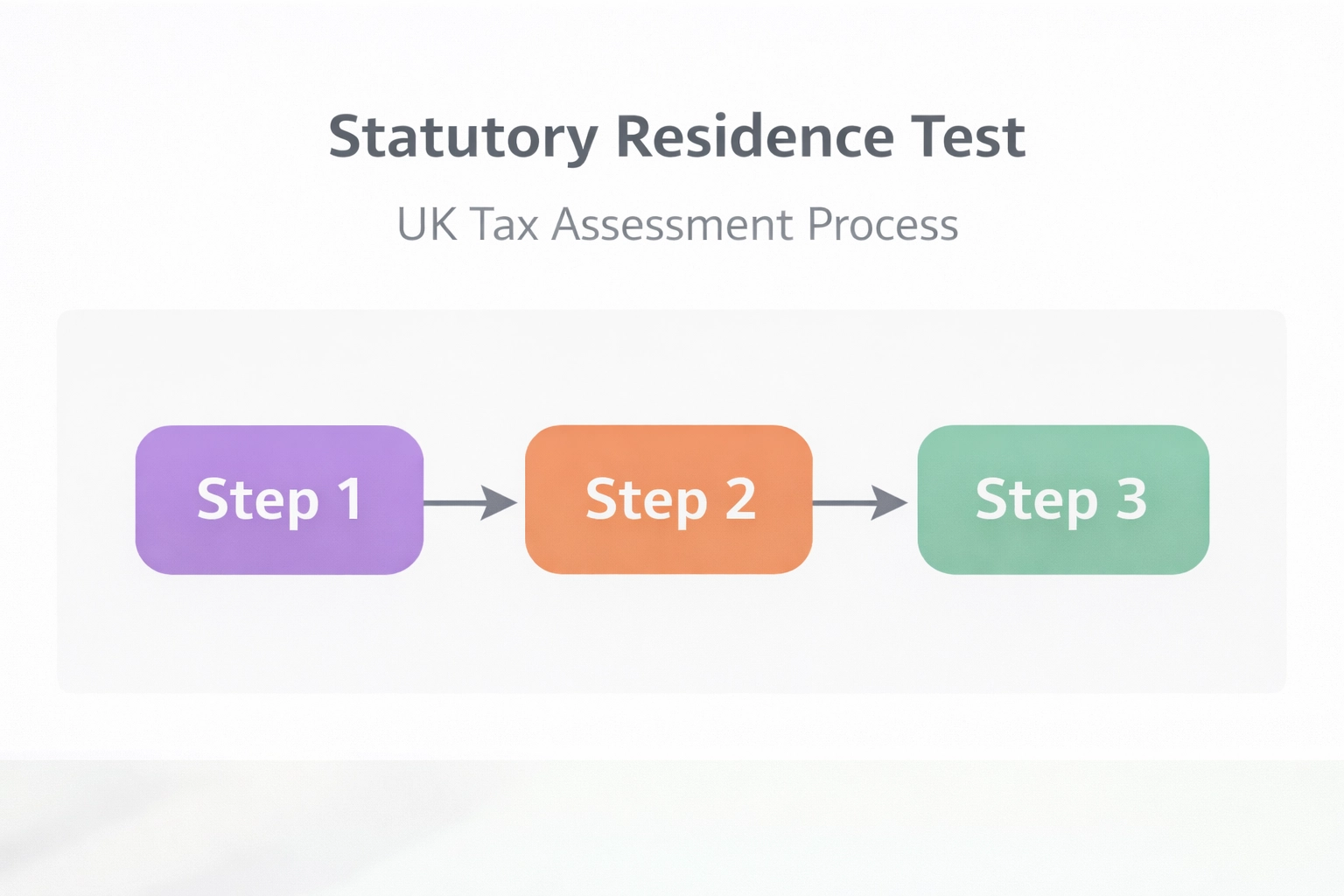
To determine your resident status, you must work through a series of tests, split into three categories as follows:
Step 1: Automatic Overseas Tests Step 2: Automatic Resident Tests Step 3: Sufficient Ties Test
Once your personal circumstances and travel pattern satisfy one of the tests, this will conclude your resident status for the tax year in question.
You must work through these tests in strict priority order. You cannot jump ahead. If Step 1 determines your status, you stop there. If not, you move to Step 2. Only if neither of those steps applies do you go to Step 3.
Step 1: Automatic Overseas Tests
The first step evaluates whether you qualify as automatically non-resident. If you meet at least one of these conditions, you're non-resident for that tax year: no need to proceed further.
Physical presence
You are present in the UK at midnight on no more than 15 days (that is you being present on UK soil at 23:59 going into midnight of the following day). *this increases to 45 days once you have been non-resident for 3 complete tax years.
Full time work abroad (’FTWA’)
You are in full time work overseas which is achieved by a) working 40 hours per week, b) exercising a workday overseas every 31 days, c) exercising no more than 30 workdays in the UK and d) spending no more than 90 midnights in the UK.
You can find HMRC guidance on the automatic overseas tests here.
Step 2: Automatic UK Tests
If none of the Automatic Overseas Tests apply, you move to Step 2. Here, the SRT evaluates whether you meet any conditions that make you automatically UK resident.
Physical presence
You are present in the UK at midnight on more than 182 days (that is you being present on UK soil at 23:59 going into midnight of the following day).
UK home
You have UK home that you are present in for 30 days, the home must be available for your use for a continuous period of at least 91 days, 30 of which fall in tax year period and during the 91 day period, you must not have a home overseas or if you do have a home overseas, you must be present in that home for no more than 29 days.
Full time work UK (‘FTWUK’)
You are in full time work in the UK which is achieved by a) working 40 hours per week, b) exercising a workday in the UK every 31 days and c) exercising at least 75% of your work duties in the UK.
You can find HMRC guidance on the automatic resident tests here.
Step 3: The Sufficient Ties Test
If you are not automatically non-resident under Step 1 and not automatically resident under Step 2, the sufficient ties test determines your status.
Your UK residence position therefore depends on two factors: (a) the number of days you spend in the UK, and (b) the number of UK ties you have.
The Five UK Ties
The SRT recognizes five types of connections to the UK:
Family tie
Your spouse, civil partner, cohabitee or children aged under 18 are UK tax resident.
Accommodation tie
You have a place to live in the UK which is available for your use for a continuous period of at least 91 days and you spend at least one midnight sleeping in the accommodation if it doesn't belong to a close relative or 16 midnights if it belongs to a close relative.
Work tie
You exercise 40 or more workdays in the UK.
90 day tie
You spent more than 90 midnights in the UK in either or both of the previous two tax years immediately preceding the tax year in question.
Country tie
You spend more days in the UK than any other country. *this tie is removed once you are non-resident for 3 complete tax years.
How Ties Determine Your Status
The number of ties you have combines with your UK days to determine residence as follows:
If you were UK resident in one or more of the three preceding tax years:
You will be resident if midnights are more than:
One tie - 120 midnights
Two ties - 90 midnights
Three ties - 45 midnights
Four or Five ties - 15 midnights
If you were not UK resident in any of the three preceding tax years:
You will be resident if midnights are more than:
One tie - 182 midnights
Two ties - 120 midnights
Three ties - 90 midnights
Four ties - 45 midnights
You can find HMRC guidance on sufficient ties here.
Practical Steps for Managing Your SRT Position
Track your days carefully. The difference between 89 and 91 UK days can change how the sufficient ties rules apply. Use a spreadsheet, calendar, or app to record each UK entry and exit.
Audit your ties annually. Review the five-tie framework before each tax year begins. If you want to maintain a particular residence outcome, you must monitor accommodation, work patterns, family connections, and prior UK day counts.
Retain evidence and keep records. You do not usually provide evidence to HMRC proactively in order to state your residence position. However, HMRC can request evidence if your status is reviewed. As such, it is extremely important to track your days and retain supporting documents, such as boarding passes, travel confirmations, rental agreements, and work records, just in case. You can find further guidance on record keeping here.
Don't guess. The SRT is rules-based but detailed. If you misunderstand your position, you may file an incorrect self-assessment return or miss a claim that depends on your residence status.
When to Seek Professional Advice
The statutory residence test provides clear rules, but applying those rules to your specific circumstances requires careful analysis.
It is extremely important to be aware of the rules and to actively manage your day counts, living arrangements, and UK ties if you want to maintain your intended residence status. If you do not monitor these factors as the year progresses, your tax position can shift in a way you did not expect.
Get in touch for a confidential, no-obligation quotation.
Global Tax Consulting can complete a full SRT assessment to determine your resident status for the tax year and help you understand what that means for your UK tax obligations. If you need clarity on your position, please reach out.
Looking for the best UK tax advisor for expats? Compare specialist vs. generalist services, learn about fixed fees, and navigate the 2026 FIG regime with ease.