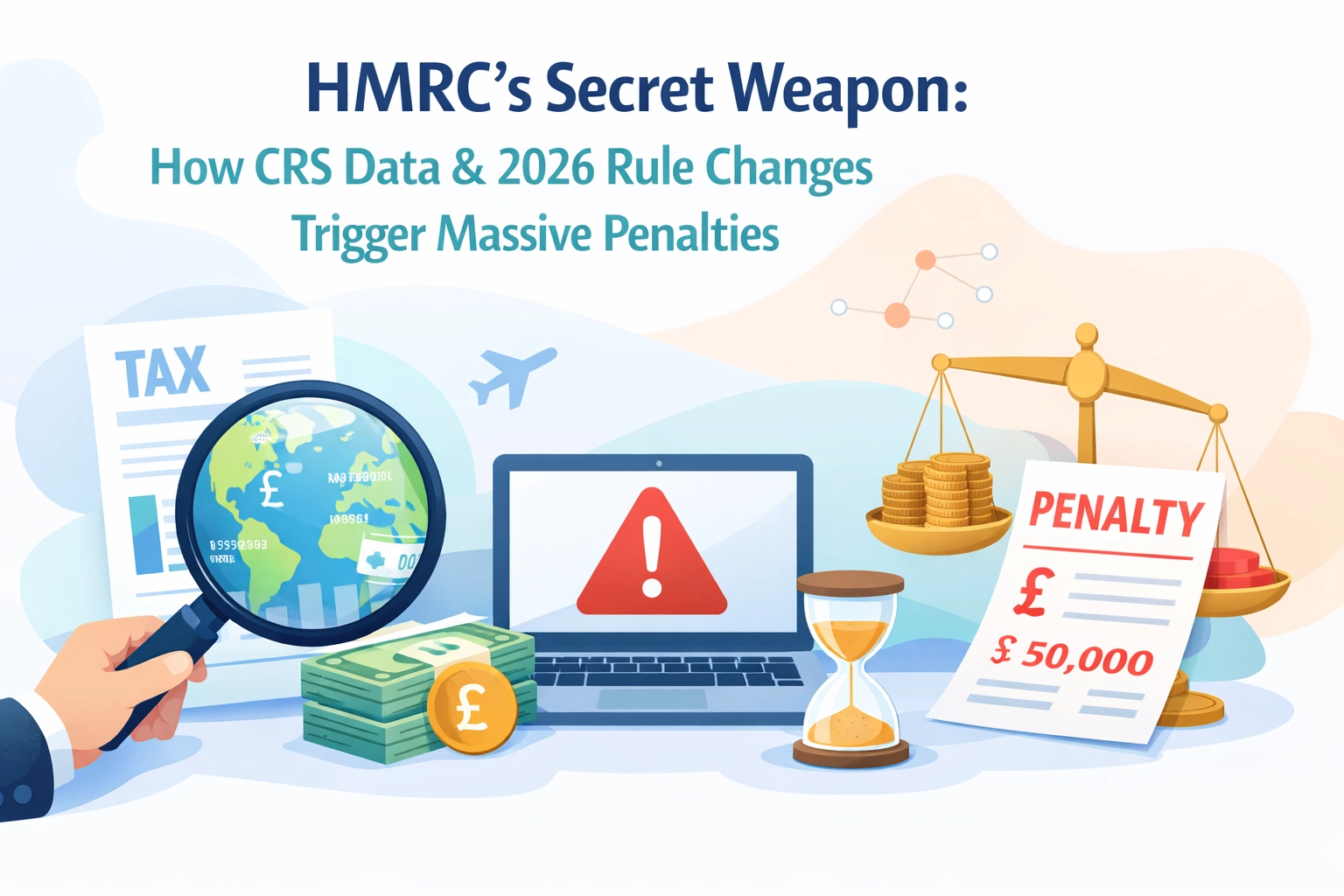
If you believe your offshore bank accounts, overseas rental income, or digital wallet balances are invisible to HMRC, you are operating on outdated information. As of March 2026, the era of financial secrecy has effectively ended. HMRC now possesses a "Secret Weapon" that processes billions of data points from around the globe with clinical precision.
This weapon is the Common Reporting Standard (CRS), and in 2026, it has been upgraded with new powers that leave almost no corner of the financial world unturned. If you have undeclared offshore assets, the question is no longer if HMRC will find out, but when they will issue a formal inquiry.
The Invisible Net: What is CRS?
The Common Reporting Standard is an information-gathering initiative where over 100 countries automatically exchange financial account information. Gone are the days when HMRC had to request information about a specific individual. Today, the process is automated, digital, and relentless.
Every year, foreign financial institutions report data about accounts held by UK tax residents to their local tax authorities, who then beam that data directly to HMRC. This data includes:
Your full name and address.
Your Tax Identification Number (TIN).
Account balances and valuations.
Total gross amount of interest, dividends, and proceeds from the sale of assets.
HMRC feeds this data into "Connect," a highly sophisticated AI social-network analysis system. Connect cross-references this offshore data against your UK tax returns. If there is a discrepancy: for example, if you hold a bank account in Dubai or a rental property in Spain that hasn't appeared on your self-assessment: the system flags you for investigation.
The 2026 Upgrade: No More Places to Hide
While CRS has been around for years, January 1, 2026, marked a significant turning point in how HMRC receives and processes this data. Two major changes have shifted the landscape significantly for expats and high-net-worth individuals.
1. The Expansion to E-Money and Crypto-Assets
For a long time, many individuals felt safe holding funds in e-money institutions or digital payment platforms, believing these fell outside the "traditional banking" definitions of CRS. As of the 2026 reporting cycle, the Automatic Exchange of Information (AEOI) regulations have been formally expanded.
HMRC now receives data from e-money providers and custodial crypto-platform operators. If you have been using overseas digital wallets to store income or gains, that data is now flowing into HMRC’s database.
2. The Arrival of the "Nudge Letter"
Have you recently received a letter from HMRC titled "Your Overseas Assets, Income or Gains"? This is what the industry calls a "nudge letter." It is not a random inquiry; it is a calculated move.
When HMRC sends a nudge letter, it usually means they have already received data via CRS that suggests you have offshore interests. They are giving you a window of opportunity to come forward before they open a formal, and much more expensive, investigation.
Receiving a nudge letter is a critical moment. If you ignore it, or provide a dishonest response, you move from the "careful" category into the "deliberate" category in the eyes of the tax inspector. As such, Global Tax Consulting recommends seeking immediate professional advice before responding to any correspondence regarding offshore assets.
The Penalty Trap: Prompted vs. Unprompted
HMRC’s penalty regime is designed to reward honesty and punish concealment. The cost of being "found out" is significantly higher than the cost of "coming clean."
The severity of the penalty depends on whether your disclosure is unprompted (voluntary) or prompted (HMRC caught you first).
Unprompted (Voluntary) Disclosure
If you realize you have made a mistake and approach HMRC via the voluntary disclosure facility before they contact you, the penalties are significantly lower. In some cases of "reasonable excuse" or "non-deliberate" error, penalties can even be reduced to 0%, providing that you provide full cooperation and pay the tax and interest due.
Prompted Disclosure
If HMRC sends you a nudge letter or opens an inquiry, your disclosure is "prompted." At this stage, the minimum penalties increase sharply. If the offshore matter involves a "Category 2" or "Category 3" jurisdiction (countries that are less transparent), the penalties can be eye-watering.
The "Failure to Correct" (FTC) Penalty
The most dangerous weapon in HMRC’s arsenal is the "Failure to Correct" penalty. For offshore non-compliance, HMRC can charge:
A standard penalty of 100% to 200% of the tax due.
An additional "asset-based" penalty in extreme cases.
Potential "naming and shaming" on HMRC’s public list of deliberate tax defaulters.
By way of example, if you owe £50,000 in tax from an undeclared overseas property gain, a 200% penalty could turn that bill into £150,000 plus interest.
Why You Should Act Now
Providing that you take action before HMRC knocks on your door, you retain a level of control over the process. Global Tax Consulting assists clients in navigating the complexities of the Worldwide Disclosure Facility (WDF), ensuring that the narrative presented to HMRC is accurate, professional, and designed to minimize exposure.
The 2026 rules also mean that financial institutions themselves are under more pressure. They now face civil penalties of up to £1,000 for failing to register or for inadequate due diligence. To protect themselves, banks are becoming increasingly aggressive in "off-boarding" clients who cannot prove their tax compliance. This means your accounts could be frozen if the bank suspects you haven't declared them to HMRC.
Simple Steps to Protect Yourself
To achieve tax compliance and avoid the 200% penalty trap, you should follow these steps:
Conduct a Self-Audit: Review all overseas bank accounts, e-money wallets, and rental properties held since 2012.
Verify Your Residency Status: Use the Statutory Residency Test (SRT) to confirm your UK tax obligations. Note that even if you live abroad, you may still have UK reporting requirements for certain types of income.
Evaluate the FIG Regime: If you have recently moved to the UK, check if you qualify for the new Foreign Income and Gains (FIG) regime, which replaced the old non-dom rules in 2025.
Make a Voluntary Disclosure: If you find a discrepancy, use the formal channels to tell HMRC before they tell you.
How Global Tax Consulting Can Help
The rules surrounding offshore disclosure are dense and fraught with risk. A single mistake in a disclosure can lead HMRC to believe you are being "deliberately misleading," which triggers the highest penalty brackets. We provide a buffer between you and HMRC. Our team of experts specializes in:
Analyzing CRS data risks.
Handling responses to HMRC nudge letters.
Preparing and submitting robust voluntary disclosures.
HMRC already has the data. The only variable left is how you choose to handle it. If you are concerned about undeclared offshore income or have received a letter from HMRC, the time to act is now.
Get in touch for a confidential, no-obligation quotation.
To discuss your situation in confidence, you can reach out to us through our via submitting our request a quote form or explore more about our voluntary disclosure service. Protect your assets, settle your position, and move forward with peace of mind.
Digital Nomad Tax Guide: Working for a UK Company Abroad
Working remotely for a UK company? Learn the "feet on the ground" rule, how to stop paying UK tax via PAYE, and how to claim a tax refund from HMRC.
Emma McDermott
Mar 21, 2025
Leaving the UK
Digital nomad
HMRC Rules for UK Income While Living Abroad
Left the UK but still earning from a UK employer, pension, or business? Discover how HMRC taxes non-residents and how to use tax treaties to your advantage.
Emma McDermott
Aug 15, 2025
Moving to the UK
Foreign income
FIG Regime 101: Guide to UK Foreign Income Relief
Moving to the UK? Learn about the new FIG (Foreign Income and Gains) regime. Our beginner's guide explains how to get a 4-year tax holiday on foreign income.
Emma McDermott
Mar 21, 2025
Leaving the UK
Digital nomad
Selling Your UK Home as an Expat?
Selling your UK home while living abroad? Learn how Capital Gains Tax (CGT) works for expats and how to report it correctly to HMRC. Get expert UK expat tax advice.
Emma McDermott
Aug 15, 2025
Leaving the UK
Moving to the UK
2026 Statutory Residence Test Guide
Master the UK Statutory Residence Test (SRT) for 2026. Learn how the automatic tests, sufficient ties, and the new FIG regime affect your expat tax status.
Emma McDermott
Feb 20, 2026
Moving to the UK
Foreign income
Forgot to Declare Foreign Income?
Missed reporting overseas earnings to HMRC? Learn how the Worldwide Disclosure Facility (WDF) works and how to fix your UK tax return without the stress.
Emma McDermott
Aug 15, 2025
Leaving the UK
UK income
HMRC’s Let Property Campaign: How to Declare Your Rental Income
Caught out with undeclared rental income? Our guide to HMRC's Let Property Campaign helps accidental landlords disclose tax safely and minimize penalties in 2026.
Emma McDermott
Mar 4, 2026
Leaving the UK
Digital nomad
UK Tax Advisor vs. DIY: CGT on Overseas Property
Selling property abroad? Compare DIY filing vs. hiring a UK tax advisor for your CGT return. Learn about HMRC's 60-day rule, currency traps, and expert tax advice for expats to avoid penalties.
Emma McDermott
Mar 1, 2026
Leaving the UK
Digital nomad
Is Your UK Exit Strategy Leakproof?
Moving abroad? Don't let HMRC follow you. Learn the 3 biggest tax pitfalls for UK expats, including the SRT test and Split-Year Treatment rules.
Emma McDermott
Feb 28, 2026
Leaving the UK
International tax
Temporary Non-Residence Mistakes: UK Expat Tax Advice
Are you caught in the 5-year trap? Avoid common temporary non-residence mistakes with our guide on the Statutory Residence Test (SRT) and UK tax for expats.